問う
プロダクトがまだ答えられない問いから始める。
Archymedes ラボ
ラボはプロダクトの根底にある問いを研究します。AI はいつ行動すべきか、知っていることは現地でも正しいか、どうすればどこでも動くほど安くできるか。方法、コード、限界を公開します。
方法
プロダクトがまだ答えられない問いから始める。
もっともらしさではなく、実際の正解と照らし合わせる。
通らないものは、どれほど便利でも外す。
論文、コード、データ、そして明記した限界を出す。
研究プログラム
誰も試していないことに、AI はいつ踏み出すべきか?
Generative models are good at proposing options and bad at choosing between them. This line of work keeps the two apart: models judge, calibrated maths decides, and an uncertain option is checked against a fallback instead of being vetoed.
成果
現地でも正しいか?
Rebuilding real places as verified, lightweight 3D scenes from free public data. Every layer is registered against the best measurement available and its error is reported; a source that fails against the ground is dropped, however convenient.
成果
普通のハードウェアで動くか?
Making capable models cheap enough to run where connections are slow or absent: compression and quantisation for small language models, and tooling that tunes GPU code without trading away correctness.
成果
論文
誰も試していないアイデアに、AI はいつ踏み出すべきか。却下するのではなく、元に戻せる形で確かめ、確認が見逃しうるリスクも見積もる。
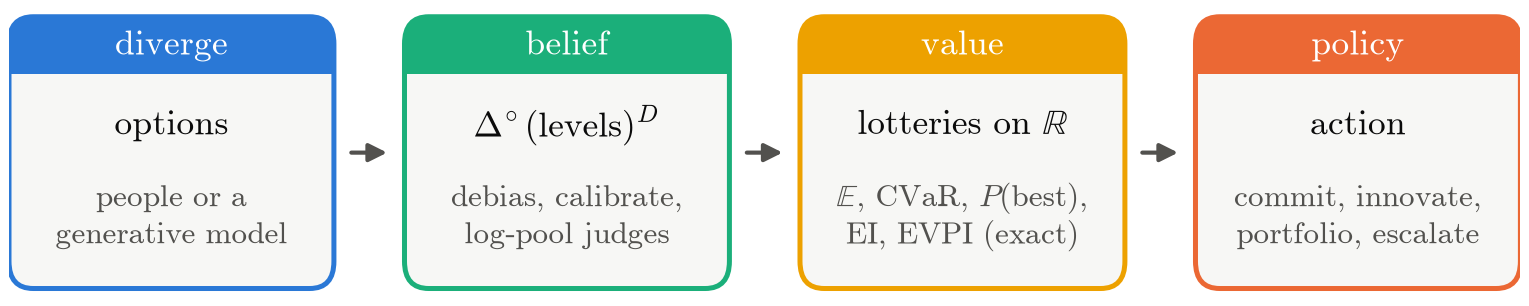
For a single decision, the value of a check depends on the belief about harm only through its mean. Ignorance and a known coin flip warrant the same action; the difference matters for learning across decisions.
On held-out synthetic problems, checking uncertain options halves the regret of vetoing them (0.045 vs. 0.091) at about 1% undetected harm, against 17–23% for acting on them unchecked.
Over 237 TypeSafe Jev judgments with known ground truth, Jev separates explicit harm from explicit safety almost perfectly (AUROC 0.9998), and cdm has the lowest regret and harm of the policies compared.
The gain comes from checking, not from the CVaR reliability gate; the Jev benchmark is small and templated; none of this yet shows better decisions on real outcomes.
原則オープン
ラボが公開する結果には、それを確かめるために必要なものが揃っています。ベンチマークが小さい、データが粗いといった点も論文に明記します。