Ask
Start from a question a product cannot answer yet.
Archymedes Lab
The lab studies the questions underneath our products: when an AI should act, whether what it knows is true on the ground, and how to make it cheap enough to run anywhere. We publish the method, the code and the limits.
Method
Start from a question a product cannot answer yet.
Test against ground truth, not against how plausible it looks.
Drop what fails, however convenient it is.
Release the paper, the code, the data and the stated limits.
Programmes
When should an AI act on something nobody has tried?
Generative models are good at proposing options and bad at choosing between them. This line of work keeps the two apart: models judge, calibrated maths decides, and an uncertain option is checked against a fallback instead of being vetoed.
Outputs
Is it true on the ground?
Rebuilding real places as verified, lightweight 3D scenes from free public data. Every layer is registered against the best measurement available and its error is reported; a source that fails against the ground is dropped, however convenient.
Outputs
Can it run on ordinary hardware?
Making capable models cheap enough to run where connections are slow or absent: compression and quantisation for small language models, and tooling that tunes GPU code without trading away correctness.
Outputs
Publications
When should an AI act on an idea nobody has tried? Check it against a fallback instead of vetoing it, and price what the check can miss.
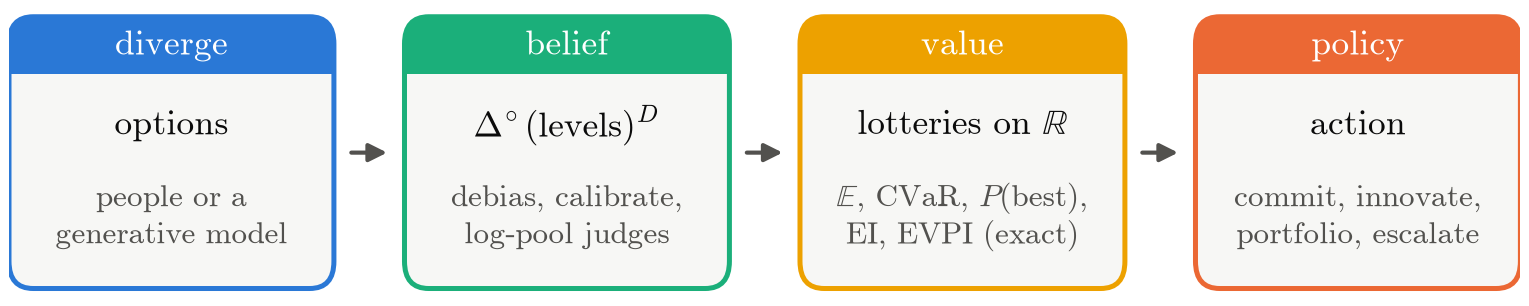
For a single decision, the value of a check depends on the belief about harm only through its mean. Ignorance and a known coin flip warrant the same action; the difference matters for learning across decisions.
On held-out synthetic problems, checking uncertain options halves the regret of vetoing them (0.045 vs. 0.091) at about 1% undetected harm, against 17–23% for acting on them unchecked.
Over 237 TypeSafe Jev judgments with known ground truth, Jev separates explicit harm from explicit safety almost perfectly (AUROC 0.9998), and cdm has the lowest regret and harm of the policies compared.
The gain comes from checking, not from the CVaR reliability gate; the Jev benchmark is small and templated; none of this yet shows better decisions on real outcomes.

Open by default
Every result the lab publishes comes with what is needed to check it. Where a benchmark is small or a dataset coarse, the paper says so.