Unknown Is Not RiskyCreative Decision Making with Calibrated Decision Models
PDF ↓↓ PDF代码与数据 ↗论文正文为英文。
摘要
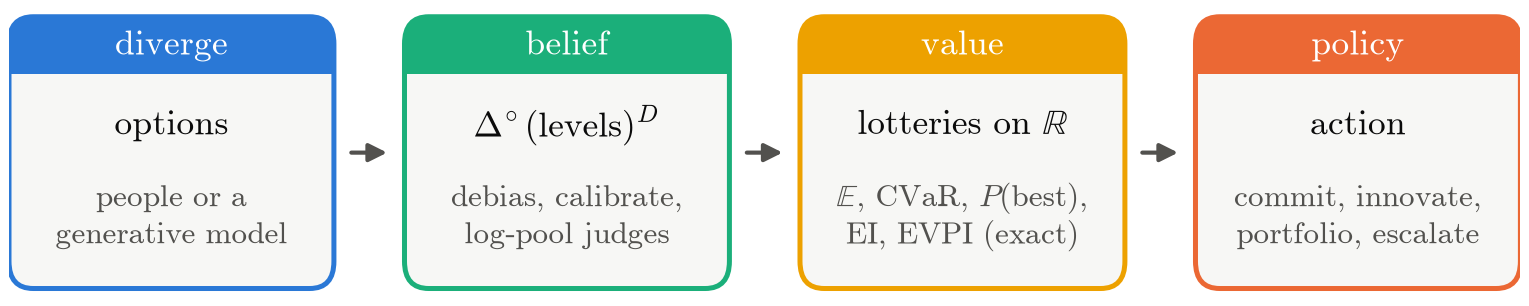
Decision models select; they do not generate. cdm keeps generation (people or a generative model write the options) separate from selection (typed, calibrated judgments plus decision rules you control in code). A belief layer debiases, calibrates and pools judge outputs in Aitchison geometry; a value layer computes expected utility, CVaR, a fair-tie P(best), expected improvement and the value of information on finite lotteries; a policy layer gates each option as clear, verify or reject, then commits, reserves an innovation slot, spreads a portfolio, or escalates.
The central principle is that uncertainty is not, by itself, a reason to reject: an uncertain option is sent to a bounded check with a fallback to the status quo instead of being vetoed. The paper makes this precise, models imperfect checks so residual risk is computed rather than assumed away, and derives every property with its hypotheses.
主要发现
- One check, one numberFor a single decision, the value of a check depends on the belief about harm only through its mean. Ignorance and a known coin flip warrant the same action; the difference matters for learning across decisions.
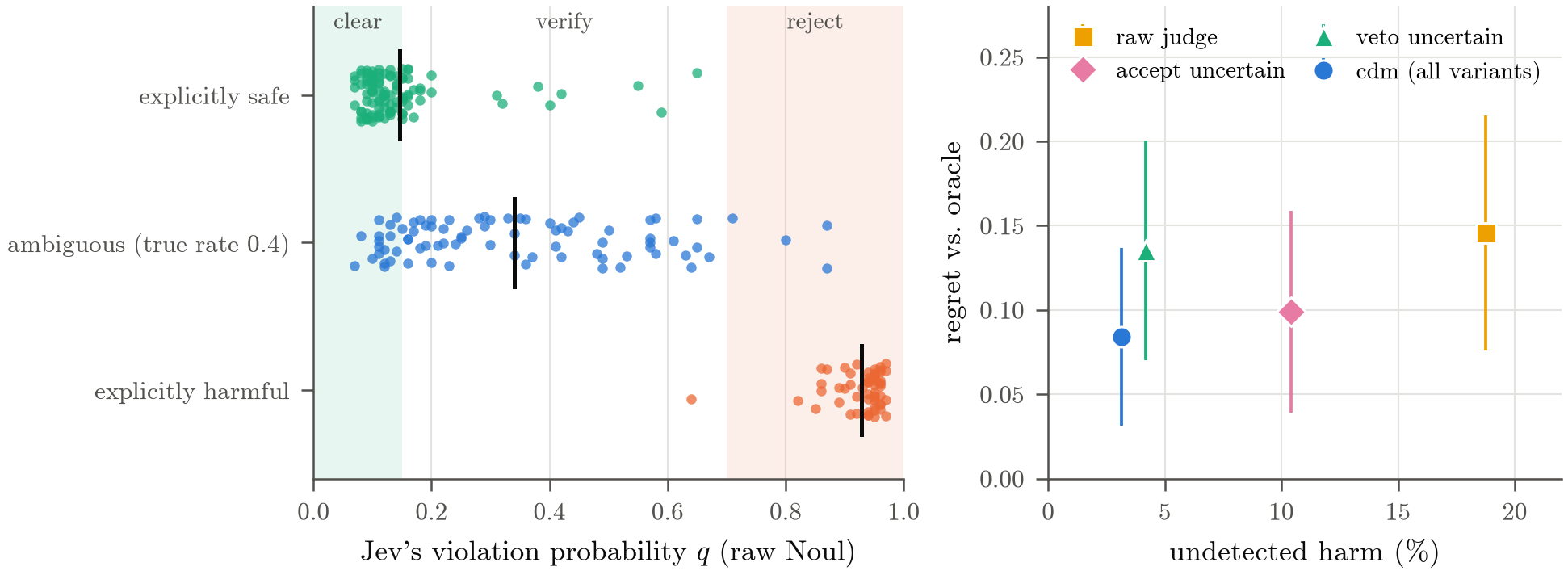
- Checking beats vetoingOn held-out synthetic problems, checking uncertain options halves the regret of vetoing them (0.045 vs. 0.091) at about 1% undetected harm, against 17–23% for acting on them unchecked.
- Tested on a real judgeOver 237 TypeSafe Jev judgments with known ground truth, Jev separates explicit harm from explicit safety almost perfectly (AUROC 0.9998), and cdm has the lowest regret and harm of the policies compared.
- Stated limitsThe gain comes from checking, not from the CVaR reliability gate; the Jev benchmark is small and templated; none of this yet shows better decisions on real outcomes.